DiffIP: Representation Fingerprints for Robust IP Protection of Diffusion Models
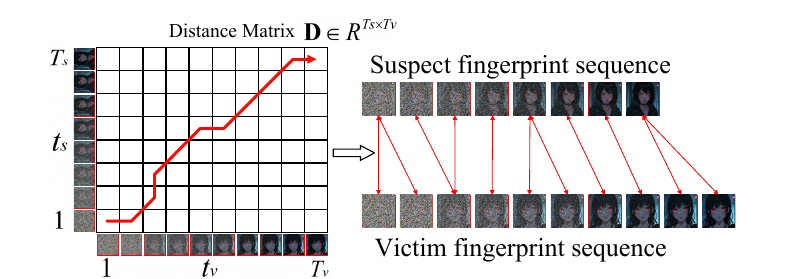
§Dynamic fingerprint sequence alignment
§Abstract
Intellectual property protection for diffusion models requires a reliable way to compare unique identifiers between suspect and victim models. Existing approaches often inject an external watermark, which must be added before release and may introduce retraining cost. DiffIP instead uses internal feature representations as intrinsic fingerprints. It reverts shifts in suspect representations and aligns their denoising trajectories with those of the victim model, enabling fingerprint comparison without modifying the protected model.
§Method
DiffIP treats the denoising process as a sequence of stochastic feature distributions and compares two models in three stages.
-
Collect fingerprint sequences. Run the suspect and victim models with the same prompt and random seeds, then collect their internal feature representations at each denoising step.
-
Revert representation shifts. Estimate orthogonal, per-dimension scaling, and translation transformations that approximately return the suspect features to the victim representation state.
-
Align denoising trajectories. Use dynamic programming to find a minimum-cost monotone alignment between fingerprint sequences, including sequences with different denoising schedules.
§Main Results
Experiments use Stable Diffusion 1.5 and FLUX-dev.1 as victim models. Each fingerprint score averages 200 prompts, with 20 random seeds sampled per prompt.
| Victim model | Derived models ↑ | Unrelated models ↓ |
|---|---|---|
| SD 1.5 | 0.9585 | 0.0789 |
| FLUX-dev.1 | 0.9344 | 0.0827 |
| Overall average | 0.9464 | 0.0807 |
| Method | FID ↓ | Robustness to fine-tuning — TPR ↑ | |||
|---|---|---|---|---|---|
| No fine-tuning | 40 steps | 1,000 steps | 10,000 steps | ||
| Stable Signature | 24.77 | 0.9930 | 0.7735 | 0.0471 | 0.0094 |
| AquaLoRA | 24.88 | 0.9900 | 0.0491 | 0.0000 | 0.0000 |
| DiffIP | 24.26 | 0.9591 | 0.9327 | 0.9259 | 0.9186 |
§Citation
@inproceedings{li2025diffip,
  title     = {DiffIP: Representation Fingerprints for Robust IP Protection of Diffusion Models},
  author    = {Li, Zhuoling and Qu, Haoxuan and Kuen, Jason and Gu, Jiuxiang and Ke, Qiuhong and Liu, Jun and Rahmani, Hossein},
  booktitle = {Proceedings of the IEEE/CVF International Conference on Computer Vision},
  pages     = {17035--17045},
  year      = {2025},
  doi       = {10.1109/ICCV51701.2025.01582}
}